Clean water has become one of the world’s most valuable resources. Whether it’s for drinking water, industrial production, pharmaceuticals, food processing, or desalination, Reverse Osmosis (RO) membrane technology has become the preferred solution for producing high-quality purified water.
But what exactly is an RO membrane? How does it work? Which membrane should you choose? And how can you maximize its lifespan?
This comprehensive guide answers everything you need to know about RO membranes in one place.
An RO (Reverse Osmosis) membrane is a semi-permeable membrane designed to remove dissolved salts, minerals, bacteria, viruses, and other contaminants from water by allowing only water molecules to pass through.
Unlike conventional filters that trap larger particles, an RO membrane performs molecular-level filtration, making it one of the most effective water purification technologies available today.
RO membranes are widely used in:
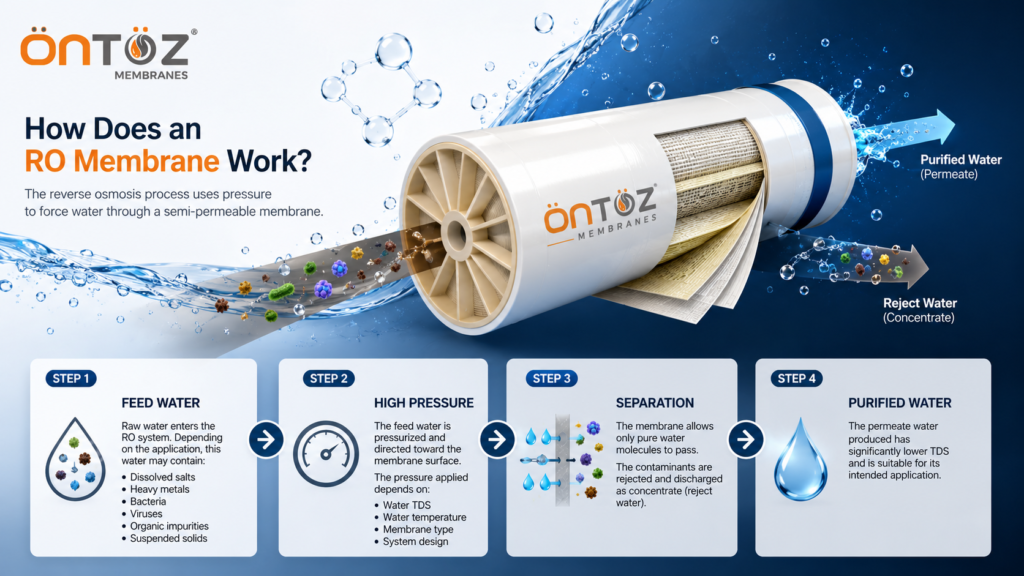
The reverse osmosis process uses pressure to force water through a semi-permeable membrane.
Raw water enters the RO system. Depending on the application, this water may contain:
The feed water is pressurized and directed toward the membrane surface.
The pressure applied depends on:
The membrane allows only pure water molecules to pass.
The contaminants are rejected and discharged as concentrate (reject water).
The permeate water produced has significantly lower TDS and is suitable for its intended application.
A complete RO system generally consists of:
Each component plays a crucial role in maintaining membrane efficiency and extending its operational life.